What Could You Teach, Simplify, Organise or Help Someone Do?
 Dee Collins
You probably know more than you think you do. And somewhere in that knowledge could be your next digital product.
Have you ever had someone say, “How do you do that?”
Or perhaps a friend has asked you to explain something for the third time because, apparently, you make it look much easier than they do.
Maybe you're the person everyone comes to when they need help getting organised. Or you know how to create beautiful Canva graphics without spending three hours staring at the screen. Perhaps you've learned how to navigate something complicated in your business, found a way to make meal planning less painful, or figured out how to get through a process that once completely overwhelmed you.
You might not think any of this as particularly special, but here's the thing…
What feels obvious to you may be exactly what someone else needs help with.
And that's where things get interesting if you've ever thought about creating a digital product.
You don't need to invent something completely new
When people hear the words digital product, they can immediately start looking for The Big Idea.
Something clever. Something nobody has ever thought of before. Something that will make people say, “Wow! Why didn't I think of that?”
And then, of course, the pressure kicks in.
I don't have an original idea.
There are already hundreds of products about that.
Who would pay me for something I know?
But your digital product doesn't have to reinvent the wheel.
In fact, it probably shouldn't.
People aren't necessarily looking for something completely new. They're often looking for a simpler way to solve a problem they're already struggling with.
Your job might simply be to take something you know and make it easier for someone else.
So, what could you teach?
Start with what you know.
Not what you think you should know. Not what you have a qualification in. And not necessarily something you've spent 20 years becoming an expert at.
Think about the things you've learned through work, life, business, hobbies, mistakes and experience.
Could you teach someone how to:
- get started with something you've already mastered?
- avoid a mistake you've made yourself?
- use a particular tool or platform?
- plan or organise something?
- make a process less complicated?
- save time?
- get better at something?
- work through a problem?
- create something?
- make a decision they're struggling with?
Your experience counts.
Sometimes “I've figured this out and here's how I did it” is more useful than an enormous, complicated course.
What could you simplify?
This is a big one.
Think about something that feels unnecessarily complicated.
Maybe you've found a way to explain it in plain English.
Maybe you've created your own checklist, process or system because the information available was confusing.
Maybe you've taken something that once took you all day and worked out how to do it in an hour.
That is valuable.
A digital product could be as simple as:
“The Beginner's Guide to…”
“The Simple Step-by-Step…”
“The No-Overwhelm Guide to…”
“Everything You Need to Know About…”
You don't have to know everything.
You just need to know enough to help someone who is a few steps behind you.
What could you organise?
Perhaps you're naturally organised.
You have lists for your lists. You know where everything is. You have a system for keeping track of your business, finances, content, meals, goals or daily life.
And maybe your system could be useful to anyone else.
It could.
People love things that make life easier.
Think planners, trackers, worksheets, checklists, templates, calendars, spreadsheets, workbooks and guides.
You aren't necessarily selling information.
You're selling clarity.
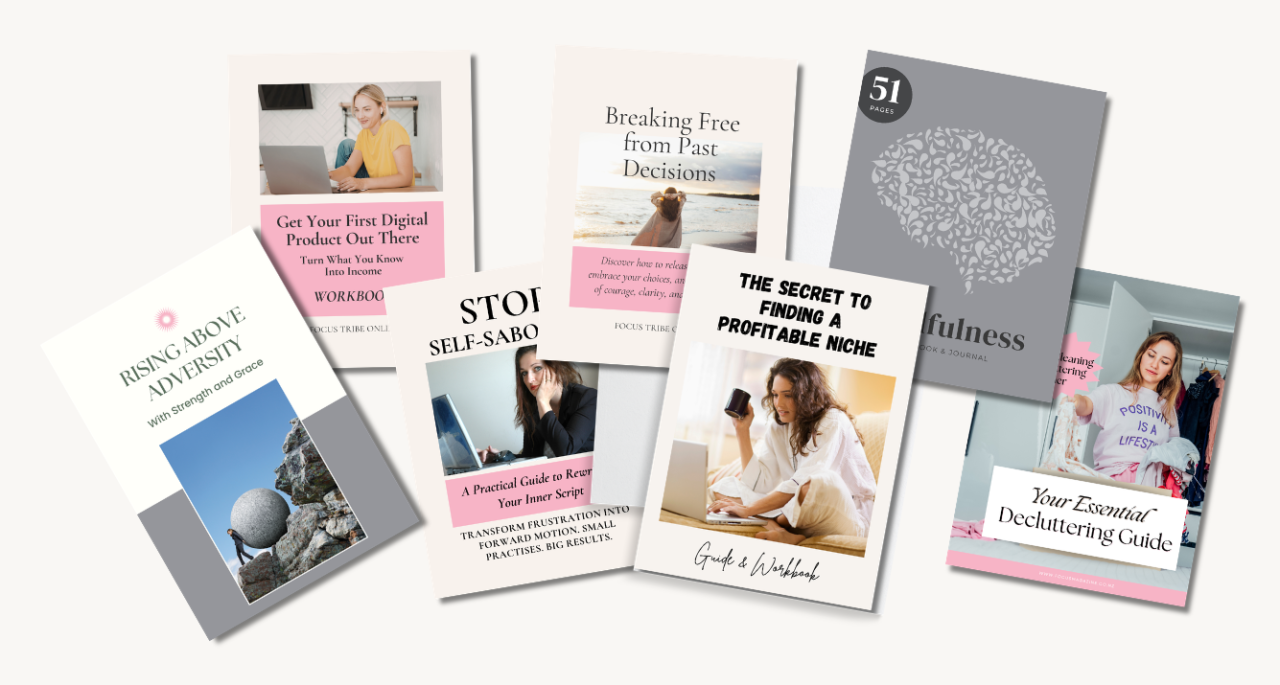
You're giving someone a starting point instead of a blank page.
And honestly, sometimes that's worth its weight in gold.
What could you help someone do?
This is perhaps the easiest question of all.
Instead of thinking:
“What do I know?”
Ask:
“What can I help someone do?”
That's a completely different way of looking at your experience.
Could you help someone:
- start a business?
- organise their week?
- plan a holiday?
- create a budget?
- get their inbox under control?
- learn Canva?
- create better social media content?
- plan their meals?
- declutter their home?
- prepare for a job interview?
- start journaling?
- get their first garden growing?
- make their first digital product?
And there's another question worth asking:
What do people already come to you for help with?
That can be a goldmine of ideas.
Your knowledge doesn't have to be complicated
There's a funny thing that happens as we become experienced at something.
We stop noticing how much we know.
We think, “But everyone knows that.”
They don't.
Or perhaps they technically could find the information online, but they don't know where to start, what matters, what to ignore or what order to do things in.
That's where you can help.
You can take your knowledge and turn it into something that saves someone else time, frustration or a whole lot of Googling.
And it doesn't have to be a 100-page ebook.
Your first digital product could be a simple workbook.
A checklist.
A collection of templates.
A short guide.
A planner.
A mini training.
A step-by-step resource.
Something small that solves one specific problem.
In fact, starting small can be a very good thing.
Try this little exercise
Grab a piece of paper and finish these sentences:
People often ask me how to…
I'm really good at…
I've figured out how to…
I could save someone time by showing them…
I could make _______ much simpler.
I've learned from my mistakes that…
I have a system for…
I could help someone who is struggling with…
Don't overthink your answers.
And don't immediately dismiss an idea because “someone else already does that.”
You're not trying to be the only person in the world who knows how to do something.
You're looking for a problem you understand and a person you can help.
And there's your starting point
Your first digital product doesn't have to be your life's masterpiece.
It doesn't need to change the world.
It doesn't even need to become a huge business.
It simply needs to be useful.
Think about something you know that could make someone else's life a little easier, clearer, quicker or less overwhelming.
Then ask yourself:
Could I turn that into something someone could download, work through, use or learn from?
If the answer is yes, you might just have the beginnings of a digital product.
And suddenly, “I don't have anything to sell” starts to look a little different.
Because maybe you do.
Maybe you've just been overlooking what you already know.
Ready to get started but not quite sure what to do?
If you're thinking “Okay, I can see how this could work, but I still have no idea what my digital product should actually be!” – that's exactly why I created Get Your First Digital Product Out There.
It's a guided workshop designed to help you take what you already know and turn it into your first digital product. We'll work through choosing an idea, figuring out what your product should look like, creating it and deciding how and where to sell it.
You don't need to arrive with a brilliant business idea or have everything figured out. We work through it together, step by step, so you can stop thinking about creating a digital product and actually get your first one out there.
Find out more about Get Your First Digital Product Out There
Categories: : Business tips, Motivation